|
Laura Park, Beloved Community Staff Team
On November 30, Angela Wilcox and I presented the last of four programs on the Double Helix Model of Faith Formation and Antiracist Multiculturalism. This Wellspring Wednesday program focused on the characteristics of white dominant culture and the practice of the antidotes to those characteristics as a way of making the antiracist multicultural practices side of the Double Helix more concrete. We briefly described these four characteristics:
Angela noted that how you react to not understanding the double helix is a wonderful opportunity for practicing the antidotes to white supremacy culture. There was a collective moment of recognition when Angela said that the problem isn’t that you don’t understand, the problem is that you’re uncomfortable with not understanding. “So what will you do about your discomfort?” she asked. Angela also shared the research about how learning to speak a second language requires developing a tolerance for ambiguity. She suggested that exploring and practicing the Double Helix is actually learning a new language. We provided each table with a handout of the antidotes to the four characteristics as well as a list of possible spiritual practices. These spiritual practices included:
We asked each table group to pick one of the characteristics and discuss three questions:
Right to comfort was chosen by the most groups, but the one perfectionism group ended up being the largest. When the groups reported back on their discussion, the perfectionism group shared that they struggled with understanding perfectionism as problematic, rather than something to be proud of, until they could see how it limited them or affected their work/relationships. Many people recognized the importance of repetition to build skill to counter these dominant culture characteristics. As an invitation to build those skills we invited people to complete this sentence, printed on a slip of paper: “I commit to practicing the Double Helix by using _____________________ as my daily spiritual practice to live the antidote _________________. “ People chose a range of spiritual practices to help them live into the desired antidote, including using deep breathing to live the antidote of welcoming discomfort; journaling to develop a culture of appreciation; maintaining a gratitude journal to counter perfectionism; mindful walking to notice urgency; and worship and meditation to go beyond either/or thinking. Hopefully, people left the series—even just one of the sessions in the series—with a deeper appreciation for how the two sides of the Double Helix talk to one another in a life of faith. And, people were in community with others who are also grappling to understand this metaphor and model, so they know they're not alone in trying to understand.
0 Comments
But Where Are You Really From? A Very Brief Examination of the Sources of Anti-Asian Racism12/22/2022 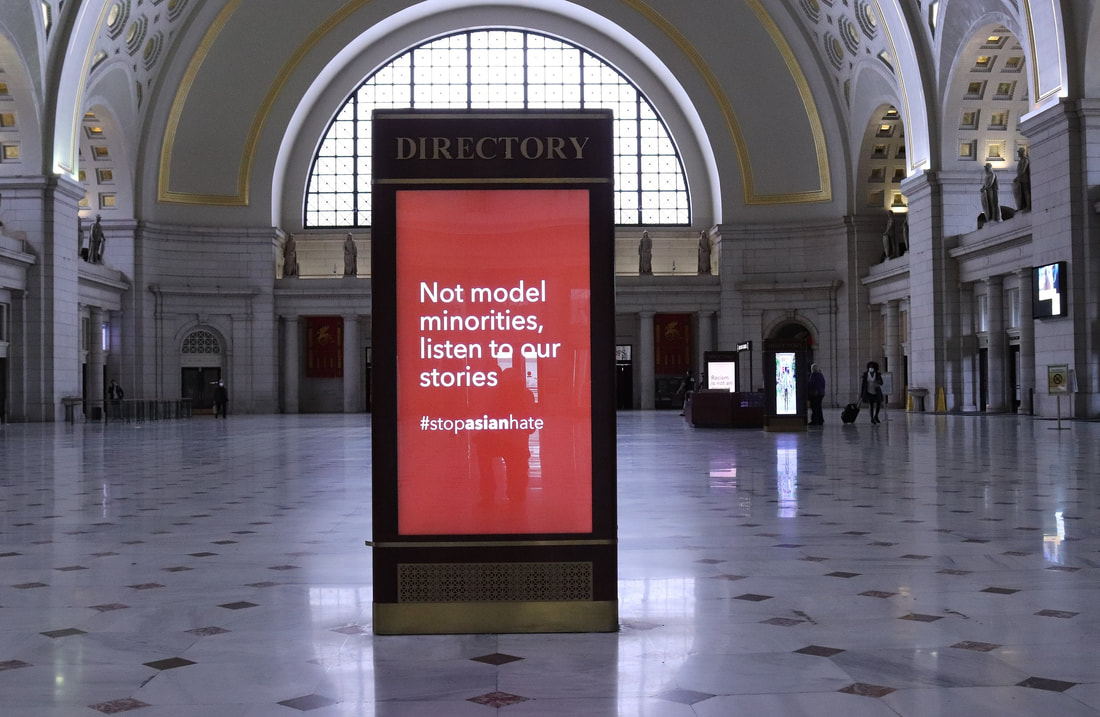 Lia Rivamonte, Beloved Community Communications Team
Recently, I found myself standing elbow to elbow in a local brewery teeming with Asian Americans grateful for the opportunity to be in community for a joyful cause — to drink beer and talk theater. Among them I recognized people whose ethnic and cultural roots were Hmong, Lao, Cambodian, Filipino, Japanese, Vietnamese, Chinese, Korean, and Indian. This only includes the people I actually know. “Asian American” serves as an umbrella term for a fast-growing 22 million people from more than 20 countries in East and Southeast Asia and the Indian subcontinent. It was Theater Mu’s Open House at the BlackStack Brewery. We were all ages but mostly people in their 20s and 30s engaged in Twin Cities’ theater-making. Also, there was a smattering of white people, funders and longtime advocates of local theater. But they weren’t the focus of the event. They were there to support the future of Mu and its 30-year legacy of art centering on the lives of Asian Americans. This Minnesota arts organization is now the second largest Asian American theater in the country. I spotted Rick Shiomi, one of Mu’s founders, who after the first 20 years relinquished his role as artistic director to make room for new leadership and has moved on to form the Full Circle Theatre Company. We reminisced about those early days of Mu and the thrill of discovering a community of Asian American artists in the Twin Cities. Rick and I joked about all the times we’ve been questioned about our origins, “No, but where are you from, really?” In fact, on a recent flight back from New York City, the woman sitting next to him queried him. “I’m from Minnesota,” he said. The woman kept drilling, uninterested in hearing where he was actually born and raised. It was only when he told her his grandfather was from Japan, that she could rest her case. She knew he was a foreigner! Yes, many of us make light of it but we all recognize the deeper implications of being constantly regarded as alien in the country in which we were born and raised, and often where our parents were born and their parents before them. When we are continually asked where we come from, however innocent the question, we understand the answer may not satisfy the need to separate us from those who “belong” here. Our physical appearance alone is enough to spark suspicion, resentment, fear, and hatred. We need not even open our mouths to speak. Historically referred to as the “Yellow Peril” it is fear rooted in xenophobia and racism and the belief that the dark forces of the East will subsume the West. To extend that further, if we identify as Asian — regardless of citizenship —we cannot be trusted to hew to our American identity at the same time. This and the long, sordid history of systemic racism and public violence against Asian Americans are the reasons why the recent spate of violence against us has unleashed in us such tremendous anger, fear, and sadness. The murder of a Chinese man in 1854 by a white person sparked the California Supreme Court ruling that people of Asian descent could not testify against a white person. Seventeen Chinese men and boys were lynched in Los Angeles in the Chinese Massacre of 1871. Racism was put into federal law by the Chinese Exclusion Act of 1882. In the Rock Springs Massacre of 1885, 28 Chinese miners were killed, and 79 homes burned down. This is just the tip of a very, very large iceberg. Most are familiar with the Japanese Internment during WWII, and the barbaric acts that our military perpetrated against citizens during the Vietnam War. In 1966, the stereotype, “model minority,” first appeared in a New York Times article. This myth perpetuated the idea that after WWII, despite internment and the wholesale destruction of their homes and businesses, Japanese Americans had quietly accepted their fate, and simply started over, refraining from asking for government aid. Instead, they worked hard, assimilated, and were “model citizens.” It was the “Why can’t you be like them?” attitude obviously directed at other nonwhites — specifically Black people that successfully pitted one group against another. In 2020, a new epidemic of anti-Asian harassment and violent acts arose in tandem with the pandemic as the President and conservative media pinned the origin and spread of the virus on China. Over 2,500 incidents of harassment and/or violence were reported in that year alone, and anti-Asian racism continues. A few of the reported pandemic induced anti-Asian racist incidents were initiated by Black men, a stark example of how the “model minority” label has served the dominant culture, sowing mistrust and envy between nonwhite groups. These examples illustrate not just individual or interpersonal racist acts but stem from the direct result of historic institutional and structural anti-Asian racism. There are more questions to answer and deep reflection is warranted, as we peel back the layers about what constitutes Asian-ess, and as we wonder how to break through the narratives imposed on us by others who want to de-humanize, demonize, and label us as “other” on one hand, and at the same time persuade us that we are somehow more “equal” or “like” the dominant culture in order to gain us as allies. One antidote to anti-Asian racism is education. There is a long, complicated history of the Asian American experience — a large, diverse, ever-evolving story — that deserves our exploration. Thirty years ago, when Theater Mu was first begun, it was rare in Minnesota to hear Asian American stories told by Asian Americans. Fortunately, much has changed since the 1990’s — we are rich in these stories and in the people who can tell them. It’s time to seek them out. Note: This is the first in a series exploring Asian American identity and anti-Asian racism. For more information on Asian Americans, find these in the Anderson Library: America for Americans: A History of Xenophobia in the United States by Erika Lee, 305.8 L Minor Feelings: An Asian American Reckoning by Cathy Park Hong, 305.4 H Pauline Eichten, with input from the Beloved Community Staff Team 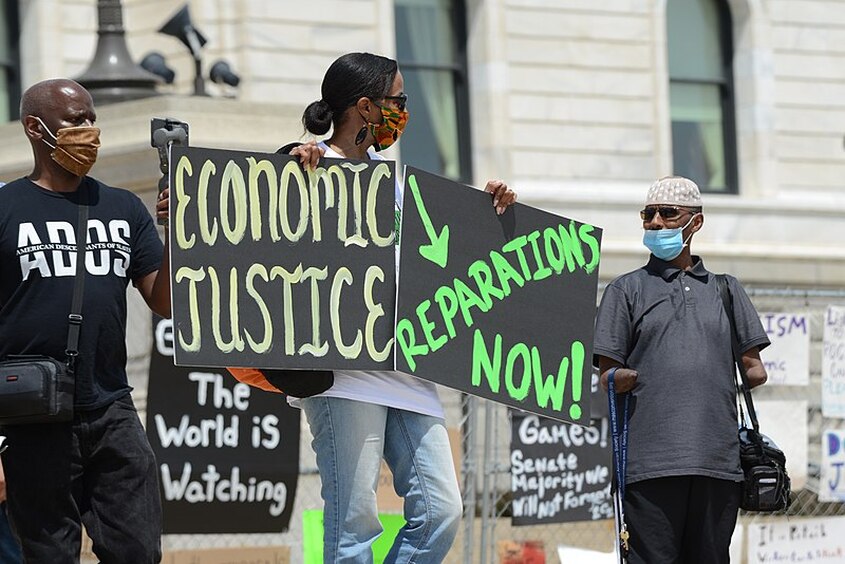 Photo by Fibonacci Blue, Creative Commons It’s timely to have this article in December, when our worship theme is wonder. How might we wonder together, with curiosity instead of judgment, about the challenge of reparations? Are we making any progress toward racial justice, as an interviewer wondered in March of 1964, when he asked Malcolm X if progress was being made. “No, no,” Malcolm replied. “I will never say that progress is being made. If you stick a knife in my back nine inches and pull it out six inches, there’s no progress. If you pull it all the way out, that’s not progress. The progress is healing the wound that the blow made. And they haven’t even begun to pull the knife out, much less heal the wound.” And when the interviewer attempted to ask another question, Malcolm interjected, “They won’t even admit the knife is there.” “Pulling the knife out” is an essential step, but it is only an act of suspending the harm. It does not “heal the wound” because it is not an act of remediation or reparation. Repairing the wound requires those culpable to make amends and restitution for the harm inflicted. The claim for restitution anchors historically on our government’s failure to deliver on the promised 40-acre land grants to the newly emancipated, a failure that lay the foundation for the enormous wealth gap that exists today between Black and white people. The case for reparations does not center exclusively on “slavery reparation” but seeks accountability for the atrocities of legal segregation we know as the Jim Crow era and the ongoing atrocities, including mass incarceration, credit/housing/employment discrimination, a criminal justice system and policing that continue to kill unarmed Black people. It includes the immense wealth disparity borne by Black American descendants, the cumulative legacy of our nation’s trajectory of racial injustice. Reparations is about repairing the wound, both acknowledging the moral failing and making restitution for lives robbed. Reparations ultimately aspires to the righting of a wronged relationship and the deep spiritual yearning for reconciliation. When asked “Why reparations?” several members of the BCST responded with these statements.
Unity Church has been on a 20-year journey to becoming an actively antiracist multicultural community. We continue to learn about the history of this country and its development and economic power built on the exploitation of African Americans and the appropriation of land from Native Americans. And we are aware of the current disparities in education, wealth, health and safety experienced by Black, Indigenous and People of Color that are an outgrowth of those foundational practices of exploitation.
The more we learn about the history of mistreatment of Black and Native Americans, and the continuing effect of that mistreatment into the present, the more it seems clear that some form of restitution must be made. Kevin Shird, in a recent column in the Pioneer Press, says compensation today for historic injustices would be a major step forward. However, beyond any monetary compensation, he stated that just the acknowledgement of the injustices committed against Black and Indigenous people matters. The need for reparations or restitution is clear. What gets complicated is how to do it and who is responsible. House Resolution H.R.- 40, named after the 40 acres and a mule promised to enslaved people after emancipation, but never given, is a bill seeking to establish a federal commission to examine the impacts of the legacy of slavery and recommend proposals to provide reparations. The bill does not authorize payments; it creates a commission to study the problem and recommend solutions. Representative John Conyers, Jr., of Michigan introduced the bill every year starting in 1989. After he retired in 2017 at age 88, Representative Sheila Jackson Lee, a Democrat from Texas, assumed the role of first sponsor of the bill. 2021 was the first year the bill made it out of committee. Locally, the St. Paul City Council established the Reparations Legislative Advisory Committee in June 2021 to lay the groundwork for the Saint Paul Recovery Act Community Reparations Commission. The Commission will develop recommendations to “specifically address the creation of generational wealth for the American Descendants of Chattel Slavery and to boost economic mobility and opportunity in the Black community.” The ordinance to create the reparations commission will be coming before the council yet this year, after which it will be Mayor Carter who appoints the commission members. It is hoped that he will do that after the first of the year. And the issue of broken treaties and restoring Native lands is a particular form of reparations that needs to be addressed. As members of the BCST seek to expand and deepen conversations about Unity’s role in reparations, watch for future articles that dig into these and other efforts addressing reparations and how this congregation might contribute. Available in Unity's Library The Color of Wealth: The Story Behind the U.S. Racial Wealth Divide Barbara Robles, Betsy Leondar-Wright, Rose Brewer, 2006 The Color of Law: A Forgotten History of How Our Government Segregated America Richard Rothstein, 2017 Available Online "The Case for Reparations," The Atlantic magazine, Ta-Nehisi Coates, 2014 Truth Telling and Healing: Indigenous and Environmental Justice Series |
Topics
All
Beloved Community ResourcesUnity Justice Database
Team Dynamics House of Intersectionality Anti-Racism Resources in the Unity Libraries Collection Creative Writers of Color in Unity Libraries The History of Race Relations and Unity Church, 1850-2005 Archives
July 2024
Beloved Community Staff TeamThe Beloved Community Staff Team (BCST) strengthens and coordinates Unity’s antiracism and multicultural work, and provides opportunities for congregants and the church to grow into greater intercultural competency. We help the congregation ground itself in the understanding of antiracism and multiculturalism as a core part of faith formation. We support Unity’s efforts to expand our collective capacity to imagine and build the Beloved Community. Here, we share the stories of this journey — the struggles, the questions, and the collaborations — both at Unity and in the wider world.
The current members of the Beloved Community Staff Team include Rev. Kathleen Rolenz, Rev. KP Hong, Rev. Lara Cowtan, Drew Danielson, Laura Park, Lia Rivamonte and Angela Wilcox. |
